The Terminale OIB English course complements and continues the work begun in Première OIB. We continue to sharpen our analytical and close reading skills as we probe issues of self and other, individual and society, assimilation and alienation. Some of our major texts are concerned in particular with race and colonization.
Saturday, December 11, 2010
Movie on Monday and Wednesday!
We're in for a treat! We're going to see the movie on Monday and Wednesday! Refer to the sheet of the week for more details...
Monday, December 6, 2010
A few practice DST questions:
1. Show how the climaxes in two works of literature that you have studied are related to the central action and give meaning to the whole work.
2.We can, at times, forgive the damage caused by the weak and the stupid; but when the damage is caused by the strong and intelligent, the action producing the damage shocks us. Develop this idea by discussing the damage produced by characters in two of the works you have studied.
3.”It is not true that suffering ennobles the character; happiness does that sometimes, but suffering, for the most part, makes men petty and vindictive.” Do you agree with these words by W. Somerset Maugham? Discuss, using two works of literature you have read.
2.We can, at times, forgive the damage caused by the weak and the stupid; but when the damage is caused by the strong and intelligent, the action producing the damage shocks us. Develop this idea by discussing the damage produced by characters in two of the works you have studied.
3.”It is not true that suffering ennobles the character; happiness does that sometimes, but suffering, for the most part, makes men petty and vindictive.” Do you agree with these words by W. Somerset Maugham? Discuss, using two works of literature you have read.
Friday, December 3, 2010
DST on Wednesday!
I will give you more information on Monday, and on the Sheet of the Week, so stay tuned...
(By the way, this is Vivien Leigh as Scarlett O'Hara. Wow.)
Sunday, November 28, 2010
What are your impressions so far?
Now that you've read the first scene, give me your first impressions of the setting, mood, and principal characters. What sort of exposition does Scene 1 provide?
Friday, November 12, 2010
Ambitious women
How do women who desire power, but live in worlds that deprive women of it systematically, express their ambition? How can they find ways to realize that desire? Think about the books we've read so far, in première and terminale, and comment on the ways female characters assert and advance themselves. What price do they pay?
Sunday, November 7, 2010
What is the role of the chorus?
What kinds of interactions do you see taking place between the chorus and the principal characters throughout the play? What is the relationship between the chorus and the audience?
Saturday, October 30, 2010
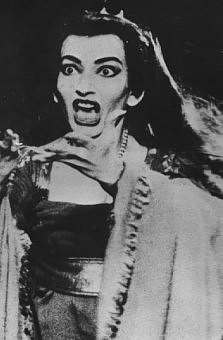
Not a woman you want to cross...
Why does Euripides seem to want us to feel pity for Medea at the start of the play? When does that pity begin to fluctuate, and perhaps change to fear and horror? What kind of tragic hero(ine) is Medea? (Hint: look at the Medea page and follow the link to Aristotle's definition of tragic hero...)
Sunday, October 17, 2010
A Room of One's Own
First of all, check out Robin's thorough and thought-provoking notes from last week in the Recaps page. Thanks, Robin! Looking ahead: over your break, which I hope is wonderful, you will be reading a portion of Medea as well as Chapters 1 and 2 of A Room of One's Own. We'll be thinking about unconventional, powerful and (ultimately) tragic women over the next few weeks. How do women assert themselves when they live within a system that dispossesses them and deprives them of a tradition? How do you make yourself heard and respected if you have been denied access to the institutions that convey power? The character of Medea and the persona of Woolf are very different, of course, but they both raise pressing questions about female power. To be continued, with your help...
Monday, October 11, 2010
The power of rhetoric
Our main theme this week and in the weeks to come: the power of rhetoric (ways of using language, really) to move and convince an audience. Take a look at the Sheet of the Week to see what's coming up, and review Emmanuelle's recap notes in the Recap page...
Sunday, October 3, 2010
How scary is this?
Here is Shirley Temple singing her famous number, "Animal Crackers," as well as a clip in which she dances with Mr. Bojangles... What do you think?
Sunday, September 26, 2010
Beauty and power...
What is the relationship between them, in the world Morrison creates? How does race factor into this question?
Sunday, September 19, 2010
Check out Sheet of the Week...
by clicking on the page! Note that the summer reading assessment will be on Wednesday, in class, and you will be asked to write on both The Bluest Eye and The Poisonwood Bible...
Thursday, September 16, 2010
On Monday...
We'll wrap up our group work on the seasonal structure of The Bluest Eye, and then groups will report to the rest of the class on their sections. Also, remember we are having the summer reading assessment on Wednesday, so use your weekend time to review both texts. Thanks for your good work!
Sunday, September 12, 2010
Take a look...
at the Sheet of the Week page near the top of our blog. It will give you a sense of what's coming up next week...
Monday, September 6, 2010
Welcome, Terminales!
This blog will be a way for us to communicate, share ideas, and build critical dialogues outside the space of the classroom. It will be a convenient place to look for assignments, schedule changes, and helpful links of all sorts. I look forward to getting to know each of you online!
Preparation for DST on Wednesday, September 15
Hello, all. As you'll have heard by now, we are having a DST ('Devoirs sur table') during the double period on Wednesday, September 15. You will be asked to compare any two of the major texts of last year in an in-class essay. You may NOT use the summer reading texts.
To refresh your memories, take a look at the Première texts page under the category of 'pages' on this blog. I've included some links that may be helpful in reminding you of the contexts of some of the works. However, the best way for you to prepare will be to look at last year's class notes, your old papers and the compos, and go through the annotated texts of the works you plan to focus on.
The DST is not a major grade, but rather a way to refocus, get back into the practice of essay writing, jog our memories about last year's texts and issues, and form a basis for continuing to build on much of the work you've already done. It will also be a way for me to see how you write, particularly those of you who are new to me. Relax, don't worry, and cast your minds back...
To refresh your memories, take a look at the Première texts page under the category of 'pages' on this blog. I've included some links that may be helpful in reminding you of the contexts of some of the works. However, the best way for you to prepare will be to look at last year's class notes, your old papers and the compos, and go through the annotated texts of the works you plan to focus on.
The DST is not a major grade, but rather a way to refocus, get back into the practice of essay writing, jog our memories about last year's texts and issues, and form a basis for continuing to build on much of the work you've already done. It will also be a way for me to see how you write, particularly those of you who are new to me. Relax, don't worry, and cast your minds back...
Subscribe to:
Comments (Atom)